The Real Sales Definition Every Remote Appointment Setter Needs

Introduction: Redefining Sales for the Remote Appointment Setter
When most people hear the word "sales," they picture pushy car salespeople, endless cold calls, or high-pressure tactics that leave a bad taste in everyone’s mouth. That image is outdated and wrong.
Here is the truth. Sales is not about tricking someone into buying something they do not need. The real sales definition is much simpler and more human. Sales is problem-solving. It is the art of listening to someone, understanding what they actually need, and then showing them how your product or service can fix that problem. In 2026, this principle is more important than ever, especially for anyone working from home.
As a remote appointment setter, you sit at the very front of the sales process. You are the first voice a potential customer hears.
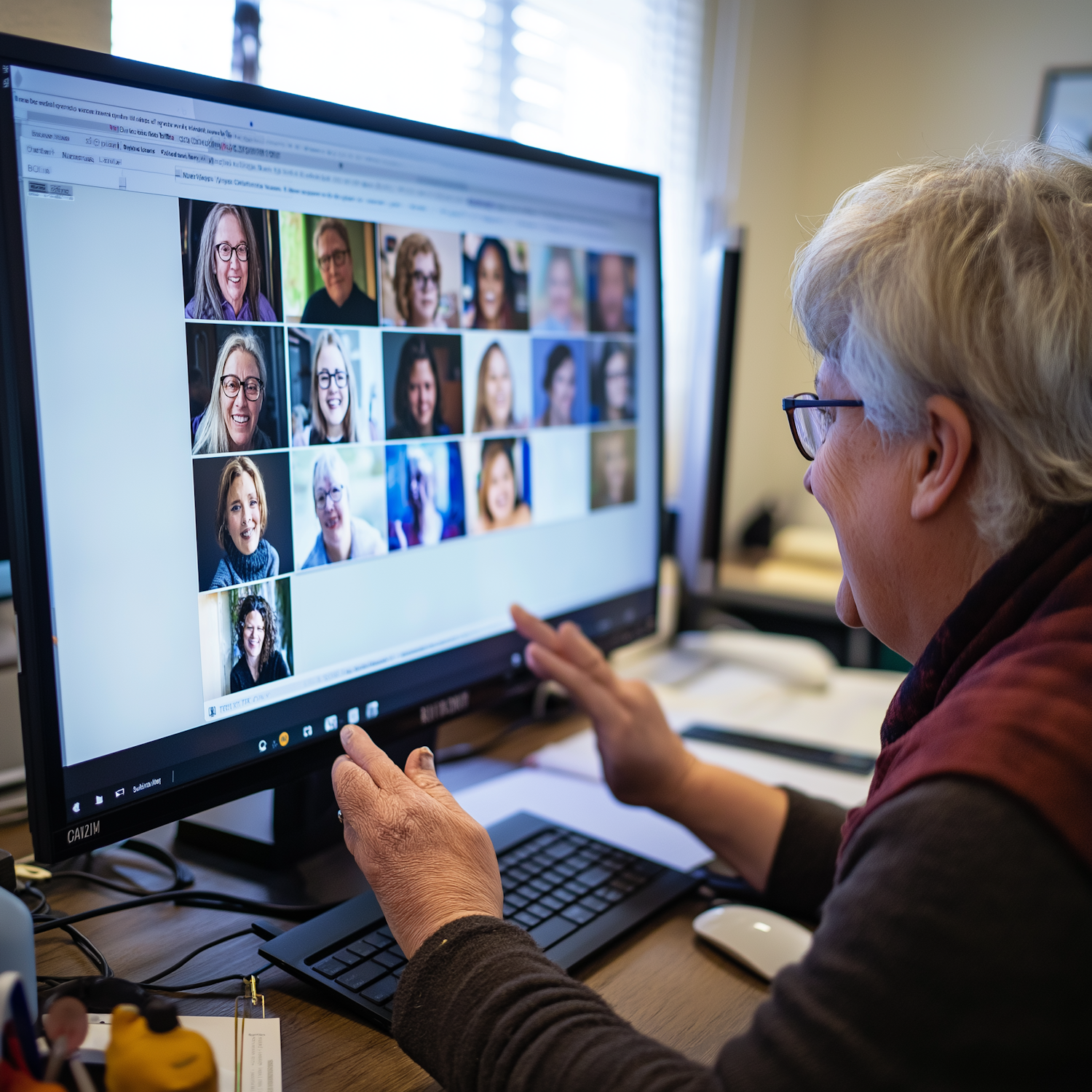
You do not close the deal, but you pave the road for the closer by making sure the right conversation happens. That means you need a solid grasp of what sales truly is before you ever pick up the phone.
A sales methodology is a framework that guides reps through the sales process, enabling them to connect with quality leads and build relationships with prospects. And when you understand the fundamentals of b2c sales or business-to-business selling, you stop feeling like a telemarketer and start feeling like a helper. You become someone who adds value, not pressure.
The goal of this article is simple. We are going to strip away the noise and give you a clear, evidence-backed foundation of sales marketing principles. You will learn what sales really means, how it connects to appointment setting, and how you can use these ideas to book more qualified meetings.
If you are new to this world, start with our complete guide on how to become a remote appointment setter in 2026. It will give you the big picture before we dive into the details of what sales is all about.
The Core Definition of Sales and Why It Matters
Let’s get down to the real sales definition. And trust me, it is not what you think.
Sales is simply the process of identifying what someone needs and showing them how your solution can help. That is it. No tricks. No pressure. Just matching a problem with an answer.

When you understand this, everything changes.
A sales methodology gives you a repeatable way to do that matching. Think of it as a roadmap. Frameworks like SPIN Selling or the Challenger Sale help you ask the right questions and build real relationships with prospects. As one expert puts it, a sales methodology "guides reps through the sales process, enabling them to connect with quality leads" SPOTIO. That sounds a lot like what you already do as a remote appointment setter, right?
Here is where many people get confused. They mix up sales marketing with actual selling. Marketing is about creating interest and drawing people in. Your job as an appointment setter is to take that interest and turn it into a real conversation. You are the bridge. Without you, the marketing effort leads nowhere.
Now, let’s talk about the psychology behind it all. There are three principles that make or break your calls:
- Trust. People buy from people they like and believe. On that first call, be genuine. Listen more than you talk.
- Reciprocity. Give something valuable first. A helpful tip. A free resource. When you give, people naturally want to give back by staying on the line or agreeing to a meeting.
- Social proof. Mention how others like them have benefited. It is not bragging. It is showing that your solution works.
These principles apply directly to your b2c sales or B2B calls. The same psychology works whether you are selling to a busy parent or a corporate buyer.
Understanding what is sales at this deeper level changes how you approach every call. You stop feeling like a telemarketer and start feeling like a guide. You become the person who makes the customer’s life easier.
Want to sharpen these skills even more? Check out our guide on how to use business administration skills to become a better remote appointment setter. It will help you manage your pipeline like a pro.
When you know the real definition, you stop pushing and start helping. And that is exactly what gets you more booked meetings.
The Appointment Setter’s Role in the Sales Funnel
Now that you understand what sales really means, let’s talk about where you fit in. The sales funnel is a simple way to describe the journey a person takes from first hearing about a company to becoming a customer. And you, as a remote appointment setter, are the very first human they talk to.
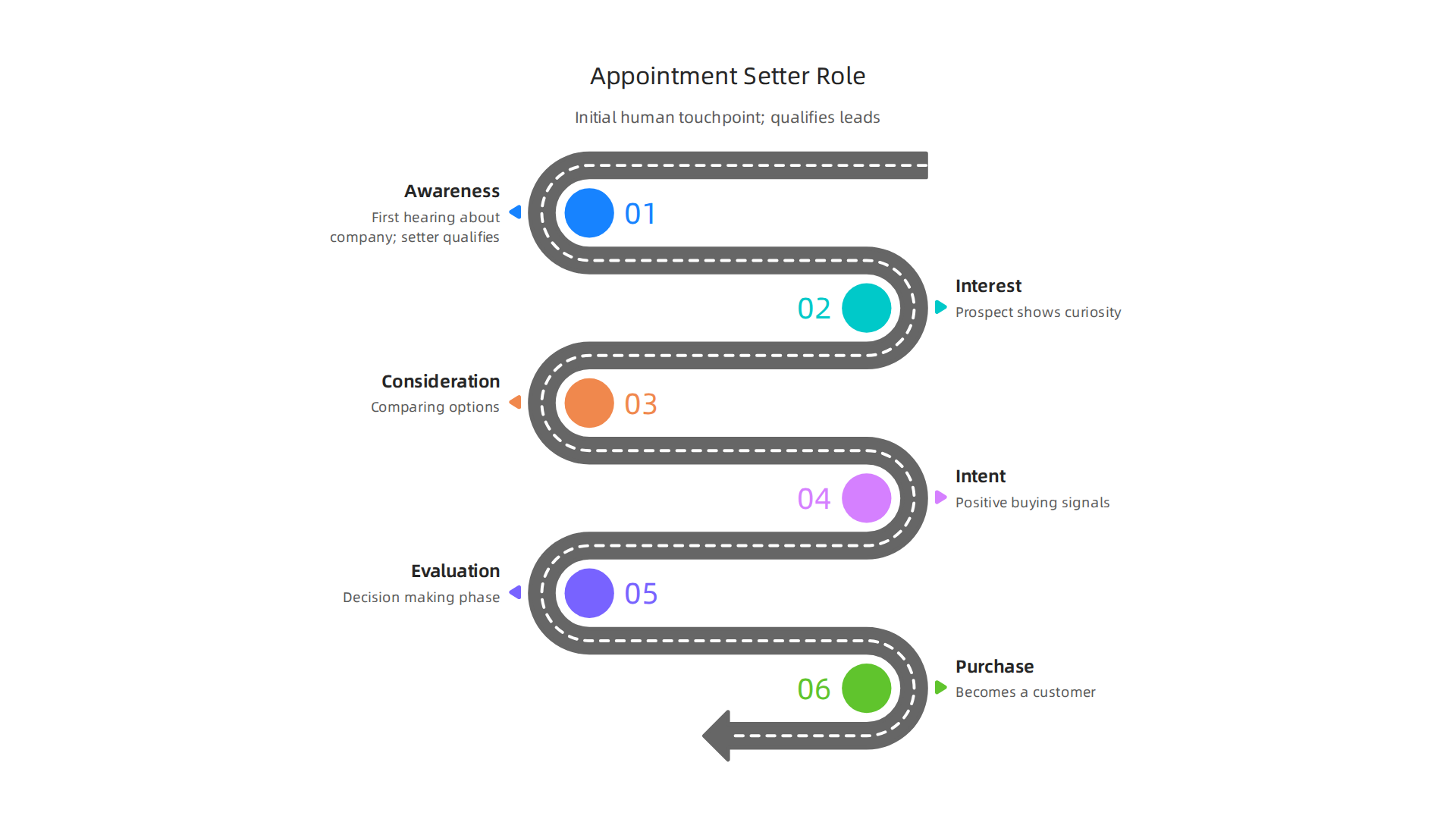
Think of the funnel like a party. Marketing sends out the invitations. That is all about creating interest. But someone has to greet people at the door, ask who they are, and decide if they should meet the host. That someone is you. You are the gatekeeper. You qualify leads and schedule discovery calls for the closer.
Without you, the funnel is broken. The marketing effort dies. The sales team has no one to talk to. According to recent job data, companies all over the country are looking for people to fill these exact roles, with remote appointment setter jobs listed on major job boards every day. The demand is real.
So what does a good appointment setter actually track? Three numbers matter most:
- Connection rate. How many of your dials actually turn into a conversation. If you are calling 100 people and only 5 pick up, you need to change your approach.
- Appointment conversion rate. Out of every conversation, how many agree to a booked meeting. This tells you how well you are qualifying and pitching.
- Lead response time. The faster you call a new lead, the more likely they are to say yes. Speed matters a lot.
To hit those numbers, you need the right tools. Most remote appointment setters use a CRM (Customer Relationship Management) system. A good CRM tracks every call, every note, and every follow-up so you never lose a lead. It helps you see your own performance over time.
One common tool is a simple spreadsheet. But as you grow, you will want something more powerful. Platforms like Salesforce, HubSpot, or even specialized tools for appointment setters can make a huge difference. They let you log calls, set reminders, and even automate follow-up emails.
Understanding the funnel helps you see that you are not just a caller. You are the person who decides who gets to move forward. That responsibility is important.
If you want to build your skills even more, check out our guide on how to switch from door-to-door sales to remote appointment setter. It will help you apply your real-world people skills to this role.
When you know where you sit in the funnel, every call has purpose. You are not just dialing numbers. You are the first step in a customer’s journey.
Essential Sales Skills for Remote Appointment Setters
Now that you understand your spot in the funnel, let’s talk about the skills that actually make you effective. You can have the best CRM and the fastest dialer, but if you cannot connect with people, nothing matters. The good news? These skills are learnable.
Active Listening and Discovery Questioning
Most people think sales is about talking. Actually, the best appointment setters barely talk. They listen.

Active listening means you hear what the prospect says and also what they do not say. You pick up on pain points, hesitation, and tiny clues about their needs.
How do you practice this on every call? Use discovery questions. These are open-ended questions that get the person talking.
- Instead of saying "Are you interested in our service?" try "What is the biggest challenge you are facing right now with [topic]?"
- Instead of "Do you have a budget?" ask "How are you currently handling this problem?"
When the prospect speaks, take notes. Respond with phrases that show you heard them, like "I understand" or "That sounds frustrating." This builds trust instantly. Without trust, you will never get the appointment.
Objection Handling Techniques
Every single appointment setter faces objections. "I am too busy." "Send me an email." "Not interested." These are not rejections. They are invitations to dig deeper.
Two techniques work really well for remote appointment setters.
Feel Felt Found. This is classic but still powerful. You say, "I understand how you feel. Many of my clients felt the same way at first. But what they found was that a quick 10 minute call saved them hours later." You show empathy, normalise the objection, and share a positive outcome.
LAER. Listen, Acknowledge, Explore, Respond. First listen fully without interrupting. Then acknowledge the concern: "I hear you, timing is tough." Then explore: "What would need to change for you to be open to a quick chat?" Then respond with a solution.
Practice these on every call. Over time, objections become predictable and easy to handle.
Scripting vs. Spontaneity
Some setters love scripts. Others hate them. Here is the truth: scripting helps you stay on track, but robotic reading kills connection.
The trick is to use a loose script. Write down the key points you need to cover. Get the opening hook right. Know your main questions and your close. But let the words come out naturally. Think of it like a map, not a railroad track.
Record yourself and listen back. Do you sound like a person or a recording? Adjust until you find your natural voice. The best appointment setters make even a scripted call feel like a friendly conversation.
If you want to see these skills in action with real examples, check out our step by step guide on how to become a remote appointment setter in 2026. It covers exactly how to practice and improve.
Companies are actively hiring for these roles. Browse remote appointment setter entry level jobs on Indeed to see what skills employers ask for. You will notice active listening and objection handling appear again and again.
Build these skills, and every call becomes a step closer to a booked meeting. You will go from someone who just dials numbers to someone who genuinely helps people decide to say yes.
Common Sales Methodologies and How They Apply to Appointment Setting
You have worked on your listening skills and objection handling. Now it is time to add a framework. A sales methodology is really just a repeatable system for having effective conversations. It gives you structure so you do not have to figure everything out on the fly. And when you know what you are doing, you sound confident and credible.
Let us look at three of the most popular sales methodologies and see how they fit into remote appointment setting.
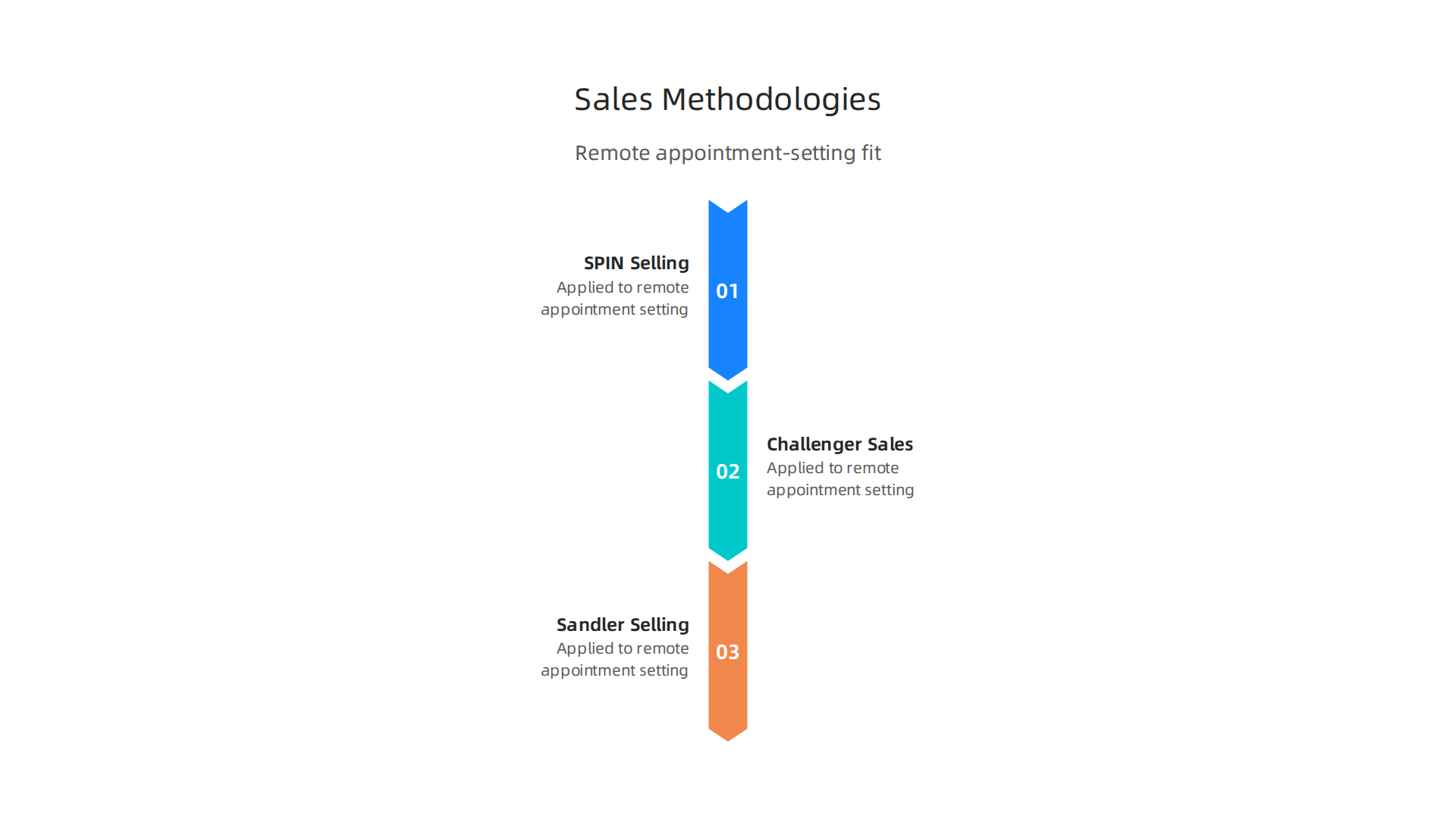
These are not just for big corporate sales teams. They work for anyone making calls from home.
SPIN Selling
SPIN stands for Situation, Problem, Implication, Need Payoff. It is all about asking the right questions in the right order. A big part of sales definition is understanding that people buy to solve problems, and SPIN helps you uncover those problems step by step.
Here is how you use it as an appointment setter.
First, ask Situation questions. "What software are you currently using?" or "How many people are on your team?" These are simple fact-finding questions. Then move to Problem questions. "Are you happy with how that is working?" or "What is the biggest bottleneck?" Next come Implication questions. "How does that delay affect your monthly revenue?" You are helping them feel the pain of not solving it. Finally, the Need Payoff question. "If you could solve that in one week, would that be worth a quick conversation?"
This methodology is very effective for discovery calls. It keeps the prospect talking and thinking. You are not selling yet. You are just uncovering why they should agree to a meeting. You can learn more about how SPIN Selling prevents objections by reading the full breakdown of SPIN Selling from IRC Sales Solutions.
Challenger Sales
The Challenger model is different. It says that the best salespeople do not just build relationships. They actually challenge the customer’s thinking. This is useful when you are talking to a gatekeeper who says "I am fine" or "We have no problems."
With Challenger, you teach, tailor, and take control. You start by teaching them something new about their industry or their own situation. Then you tailor that insight to them specifically. Finally, you take control of the conversation by leading them toward the appointment.
For example, you might say, "Most business owners I talk to do not realise they are losing 20 percent of leads just because they respond slowly. If that were happening in your business, would it be worth a call to see how we fix it?" This works well with skeptical prospects because you are showing expertise, not just asking questions. The Challenger Sale model is especially useful for selling complex solutions with longer sales cycles.
Sandler Selling
Sandler is a low-pressure system that focuses on qualifying quickly. It uses something called an "up front contract." At the start of the call, you say something like, "I would like to ask you a few questions to see if this is worth both our time. If it is not a fit, I will be the first to say so. Does that sound fair?"
This takes the pressure off both of you. Then you use a "pain funnel" to dig deeper. You lead with questions like "What is the hardest part of your day?" and "How much is that costing you?"
Sandler is perfect for appointment setters because it helps you qualify leads fast. You do not waste time on people who are not ready. You only book meetings with real buyers. For a full overview of the Sandler Selling system and its seven steps, check out this guide.
Which One Should You Use?
You do not have to pick just one. Many setters combine SPIN questions in the discovery phase with a Challenger approach when they hit resistance and a Sandler style up front contract to set expectations. Test them all and see what fits your personality.
If you want a structured path to putting these into practice, our simple guide on how to become a remote appointment setter in 2026 walks you through the exact process step by step.
Understanding these frameworks is a big part of learning what is sales in a practical way. They are not just theory. They are tools you can use on your next call. And the more you use them, the more natural they become.
Overcoming the Top Challenges Remote Appointment Setters Face
You have learned the frameworks and practiced your scripts. But let us be real. Working from home as an appointment setter comes with some serious hurdles. If you know what they are ahead of time, you can prepare for them. And that is exactly what we are going to do here.

Scams and Unqualified Listings Waste Your Time
Here is the ugly truth about remote job hunting. According to a 2026 Norton survey, 33 percent of people have come across employment scams or suspicious postings on job sites. That is one in three. And appointment setting is a favorite target of scammers. The Federal Trade Commission has specifically warned about appointment setter job scams that start on social media.
These scams often ask for money upfront or promise huge earnings for little work. They waste your time and can steal your identity. So how do you protect yourself?
You need a red flag checklist. If a job asks you to pay for training or equipment, run. If the pay seems too good to be true, it is. If they hire you without an interview, that is a huge warning. Check the company name through a business verification tool like the Utah business entity search if you suspect they are fake. There are complete guides online that list 25 warning signs of job scams in 2026. Keep that list handy.
Even legitimate listings can be a waste of time if the lead quality is poor. Some companies hand you a call list full of bad phone numbers or people who never asked to be contacted. You start dialing and get nothing but hang ups. That is not your fault. But it is your time.
Vet the opportunity before you start. Ask the hiring manager how they source leads. Ask what the average close rate looks like. If they cannot give you clear answers, keep looking. There are plenty of valid entry level remote appointment setter jobs on Indeed that come from real companies.
Skill Gaps Can Slow You Down
Many people jump into remote appointment setting with no sales background. That is okay. You can learn. But if you do not have the basic skills, you will struggle.
The number one skill gap is objection handling. We covered that earlier. Another big one is CRM experience. A lot of companies use tools like Salesforce or HubSpot. If you have never used one, it can feel like a foreign language. But you can fix that with free tutorials on YouTube and low cost courses.
The key is to not wait until you have the job to learn. Start building your skills now. Practice your scripts with a friend. Learn basic CRM navigation. Watch a free training session from a $500k+ setter to see how the pros do it.
When you show up with basic competence, you stand out from 90 percent of applicants. And that makes it much easier to land a role.
Isolation and Motivation Are Real Problems
Working alone in your home all day is hard. There is no one high fiving you when you book a meeting. There is no manager walking by to check on you. And when you hit a streak of rejection, it is easy to spiral.
I have seen setters quit after two bad days in a row. They felt like they were the only one struggling. But that is not true. Everyone has bad days.
The fix is structure. Create a daily routine that includes dedicated call blocks, breaks, and a cutoff time. Use a simple habit tracker like a paper calendar. Put a check mark every day you hit your call goal. Do not break the streak.
You can also join a community. There are Facebook groups and Discord servers for remote appointment setters. If you want a structured approach, our complete guide on how to become a remote appointment setter in 2026 includes a daily routine template that helps you stay on track.
Isolation does not have to defeat you. You just need a system and some accountability.
These challenges are real. But they are also solvable. And every time you push through one, you become stronger and more confident in your role. That confidence directly improves your understanding of what is sales really means, because sales is not just about talking to strangers. It is about managing yourself first.
Building a Long-Term Career in Remote Sales
You have made it through the hard early days. You learned the scripts, you faced the rejection, and you kept going. Now comes the good part. You can turn this role into a real career. Not just a side hustle. A career with growth, better pay, and more freedom.
Let us talk about what that actually looks like.
Income Potential: How Much Can You Really Make?
Remote appointment setting is rarely a flat salary job. Most companies use some form of commission. That means your earnings depend on how many qualified meetings you set. And that can add up fast.
Here is a quick look at the numbers. According to Glassdoor, the average salary for a remote appointment setter in 2026 is around $62,721 per year. But that number includes both base pay and commission. Some roles start with a base salary of $45,000 plus unlimited commission, according to job listings on Indeed. And there are setters who earn well over six figures.
You will see two main pay structures:
- Base pay + commission. You get a steady hourly or monthly base. Then you earn extra for each appointment that shows up or converts. This is safer and more common for beginners.
- 100% commission. You get no base. But your per-appointment bonus is higher. This works best if you already have strong skills or a quality lead list.
The earning ceiling depends on you. Top performers at good companies can make $80,000 to $100,000 or more per year. But it takes consistency. You cannot just show up and expect that. You have to treat this like a business.
Check out the entry level remote appointment setter jobs on Indeed to see real examples of base pay and commission splits.
Career Progression: Where Can You Go?
A lot of people think appointment setting is a dead end. It is not. It is actually one of the best entry points into the whole sales world. Once you can book meetings reliably, you become valuable. And companies want to promote people who can talk to prospects.
Here is a typical career path:
- Remote Appointment Setter – Your job is to book meetings. That is it.
- Closer – Some setters move into closing deals. Closers usually earn higher commissions because they handle the final sale.
- Team Lead or Sales Manager – After you master setting, you can lead a team of setters. You train them, check their calls, and help them hit targets.
- Sales Director or Operations – From there, you can move into strategy, hiring, or running an entire sales department.
Every step comes with more income and more responsibility. And the best part? You learn what is sales at a deep level. You realize that sales is not about pushing people. It is about solving problems and building trust. That skill works in any industry.
If you are coming from outside sales, check out this guide on how to switch from door to door sales to remote appointment setter. It shows you how your existing skills transfer.
Continuous Learning: Never Stop Growing
The remote sales world changes fast. AI tools are automating some tasks. Companies update their scripts. The best setters keep learning.
You do not need a college degree. But you do need to invest in your skills. Here are a few ways to keep growing:
- Free training. Watch a free appointment setting training from a $500k+ setter on YouTube. It is packed with real techniques.
- Certifications. Some platforms offer sales certifications. Even simple ones from HubSpot or Salesforce help your resume.
- Communities. Join Facebook groups or Discord servers for remote sales pros. Share wins, ask questions, and stay motivated.
- Mentorship. Find someone who is already where you want to be. Offer to help them in exchange for advice. Many top setters are happy to mentor.
Also, do not forget that you can diversify your income. Many remote appointment setters eventually start their own side business. Our guide on how remote appointment setters can start an online business with these 10 ideas gives you practical ways to expand.
Make It a Career, Not Just a Job
Remote appointment setting is not a forever role for everyone. But for many people, it is the start of a rewarding career in sales. You control your hours, your income, and your growth. If you treat it seriously, it will treat you well.
The key is to always think about the next step. What skill can you learn today that will help you tomorrow? What relationship can you build? When you start seeing appointment setting as a long-term path, your entire mindset shifts.
If you are ready to build that career from the ground up, start with the complete how to become a remote appointment setter in 2026 guide. It gives you the exact roadmap to land your first role and grow from there.
Summary
This article reframes sales for remote appointment setters, defining sales as problem-solving rather than pressure tactics and showing how appointment setters act as the vital bridge between marketing and closers. It explains where you sit in the sales funnel, which metrics matter (connection rate, appointment conversion, response time), and the CRM and tools that make your work consistent. You’ll learn practical skills — active listening, discovery questioning, objection-handling (Feel–Felt–Found, LAER), and how to use loose scripts that sound natural. The guide compares common sales methodologies (SPIN, Challenger, Sandler) and how to apply them to qualify leads and book better meetings. It also covers real remote challenges like scams, poor lead quality, isolation, and skill gaps, with concrete steps to protect yourself and improve. Finally, it shows how to grow this role into a long-term sales career, outlines typical pay structures and progression paths, and points to resources for ongoing learning and entrepreneurship.
More articles